
Marcos Monteiro, I colleague whose work I admire and who is an accomplished traditional astrologer has recently posted a video about his use of Fortuna in astrology.
Like Marcos, and John Frawley himself, most horary astrologers in John’s lineage don’t use Fortuna in Horary. That was also the case for me in the first ten years of my studies and practice. But as I began to explore Horary’s capabilities beyond its most common uses, I felt a lack of support in my endeavors. But with persistence and a good deal of analytical thinking, I found the help I needed in the chart itself. I’ll explain.
There is a very concrete reason for not using Fortuna for most horary questions. It is not simply a matter of personal preference or opinion.
Simple Horary
If the Horary questions that we usually answer are: Will I get the job? Will I get married? Will I get laid? Will I get money? Will I get pregnant? or Will the cat come back? you will not need Fortuna. We are dealing with two or three significators at most, that are clearly indicated by basic house rulership. There is only one job, one child, one money, etc. We need one aspect, maybe receptions, maybe dignity, and we get our “yes or no” answer and/or the timing. If there is no aspect it is even easier and quicker to do horary. The cat is not coming back, period.
For that kind of simple Horary astrology, we do not need further devices that are built into astrology to help the astrologer unravel the chart. There’s barely anything to unravel if the question is “will the cat come back?”—unless, of course, one may want to know why not, and what happened to the cat, or where. Usually, a missing cat is enough bad news and thus we avoid adding insult to injury. But not all querents are adverse to a fuller picture of reality and some of them do want to know more; for them we can tell more, if only we know how to see more in the chart. To see more, we need help to go beyond the basics of Horary education.
Complex Horary
When we’re dealing with complex contexts, for example, medical, mundane matters, psychological, metaphysical or spiritual questions, or to uncover the behind-the-scenes forces that are at play in just about every serious relationship question, then we rarely use one or two significators. It is more common than not to have six or seven significators in those situations. In medical astrology, it’s obvious: we have organs, systems and anatomy. We need to find those significators via house rulership, natural rulership or using the planet-in-sign system.
In those complex cases, we need additional help from the chart to allow us to interpret it accurately and/or completely. Without additional tools our interpretation must remain superficial and incomplete, at best, or wrong, at worst. The reason is simple and apparent, if we take the time to study it.
Why Fortuna Matters
Every astrological chart has two, three and occasionally four houses ruled by the same planet. In complex contexts the horary astrologer is routinely faced with house rulership ambiguity.
The basic, conservative approach is to simply not answer the question because we do not know how—even if we are attracted to or understand the context well. We lack the technical knowledge. That is honest, but limited, sadly.
For those who wish to tackle complex questions, there is help in the form of Fortuna. The chart itself will show us what we should pay attention to by strategically placing Fortuna to indicate which house we must address—often right inside or on a house cusp. Observe and you will it in many charts. This is a gift—a gem of astrological assistance.
We will not find this technique in The Horary Textbook or in a basic horary course—it doesn’t apply to simple horary astrology. It does apply to complex situations, or whenever we are required to push our chart reading beyond basic limits. Horary is generous—the information is there. With he right technique we may ready it.
The Nodes Matter Too!
Fortuna is not alone to help the peregrine astrologer. There is another device built into astrology to tell the astrologer to pay attention to certain houses. That’s the Nodes. How nice of the Moon to give us these gifts…
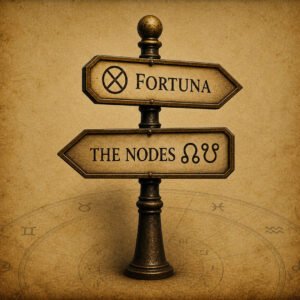
If Fortuna does not tell you where to look, the nodes will. Fortuna, as well as the Nodes, function as signposts. Using the Nodes as signposts is something I learned from John Frawley’s application in Solar and Lunar Return interpretation.
I thought, well, if it works in return charts, could it not work in horary? So, I began to pay attention. And thank god I did—there they are—they work every time.
Consider that in most horary charts the Nodes do not provide any accidental dignity testimonies; but they do provide guidance to relevant houses—either confirming a house we are already dealing with, or providing insight about an additional house that fits the context and that will enhance the reading.
Both Fortuna and the Nodes will guide the astrologer to the correct significators and the necessary houses to pay attention to. In complex horary interpretations those tools are a necessity, without which the Horary astrologer is ineffective. These two devices, built into, Horary astrology, allied with thorough analytical thinking, allow the astrologer to access breadth and depth in his/her interpretations.
The cat is not coming back.
But Fortuna inside the turned 8th cusp may help us understand why, by clarifying what the planet that prohibit the cat’s return signifies… The cat is dead. And a node on the turned 6th cusp further describes the horror that the neighbors witnessed. Sorry about the dramatic example, but the simplicity and contrast may help to make a point.
You may find many real-life examples of the concepts discussed above in the three books that I’ve written, and in my other articles and videos. Many of the charts have outcomes to corroborate the techniques used. If I cook, there must be a pudding.


